SilentAuth+ · TS.43 EAP-AKA · USSD Fallback · 2G–5G
Silent Authentication API For Every Device & Every Network.
SilentAuth+ is U2opia's silent network authentication API built on TS.43 EAP-AKA. Verify mobile identity without OTP, without friction, without a single user step. And unlike any other silent authentication platform, we don't stop at 4G.
2G–5G
Full device coverage via USSD fallback
0
User steps. Zero friction. Silent.
104+
Mobile operator networks
TS.43
GSMA Release 11 · EAP-AKA
WHAT IS SILENT AUTHENTICATION ?
Definition: Silent Authentication
Silent authentication (also called silent network authentication or zero-click authentication) is a method of verifying a user's mobile identity at the network level without sending an OTP, without any user interaction, and in milliseconds. The verification uses the SIM card's cryptographic credentials, not a transmitted code.
No code. No tap. No friction. Just verified.
Every time a user authenticates with SMS OTP, three things happen: a message is sent (costing money), the user waits and types (costing conversions), and the code travels over a network channel that attackers know how to exploit.

Silent authentication eliminates all three. The verification happens between the device's SIM card and the mobile operator's network — invisible to the user, instant for the enterprise, and cryptographically stronger than any OTP-based method.

SilentAuth+ implements silent authentication using the GSMA TS.43 Release 11 standard — the GSMA's authoritative framework for network-level device authentication using EAP-AKA (Extensible Authentication Protocol — Authentication and Key Agreement). This is the same cryptographic mechanism mobile operators use to authenticate devices to their networks at registration.
Definition: TS.43 EAP-AKA: TS.43 EAP-AKA is the GSMA standard (TS.43 Release 11) defining how a device's SIM card authenticates silently to a third-party application via an Entitlement Server and EAP-AKA cryptographic credentials. It works over both cellular (4G/5G) and Wi-Fi connections.
HOW TS.43 AUTHENTICATION WORKS
GSMA's silent network authentication standard needs USSD for global use.
TS.43 Release 11 is the GSMA's technical specification for Network Authentication via Entitlement Server. It defines how a mobile device's SIM card can prove its identity to a third-party application using EAP-AKA cryptographic credentials (the same mechanism used for SIM registration) without sending any message to the user.

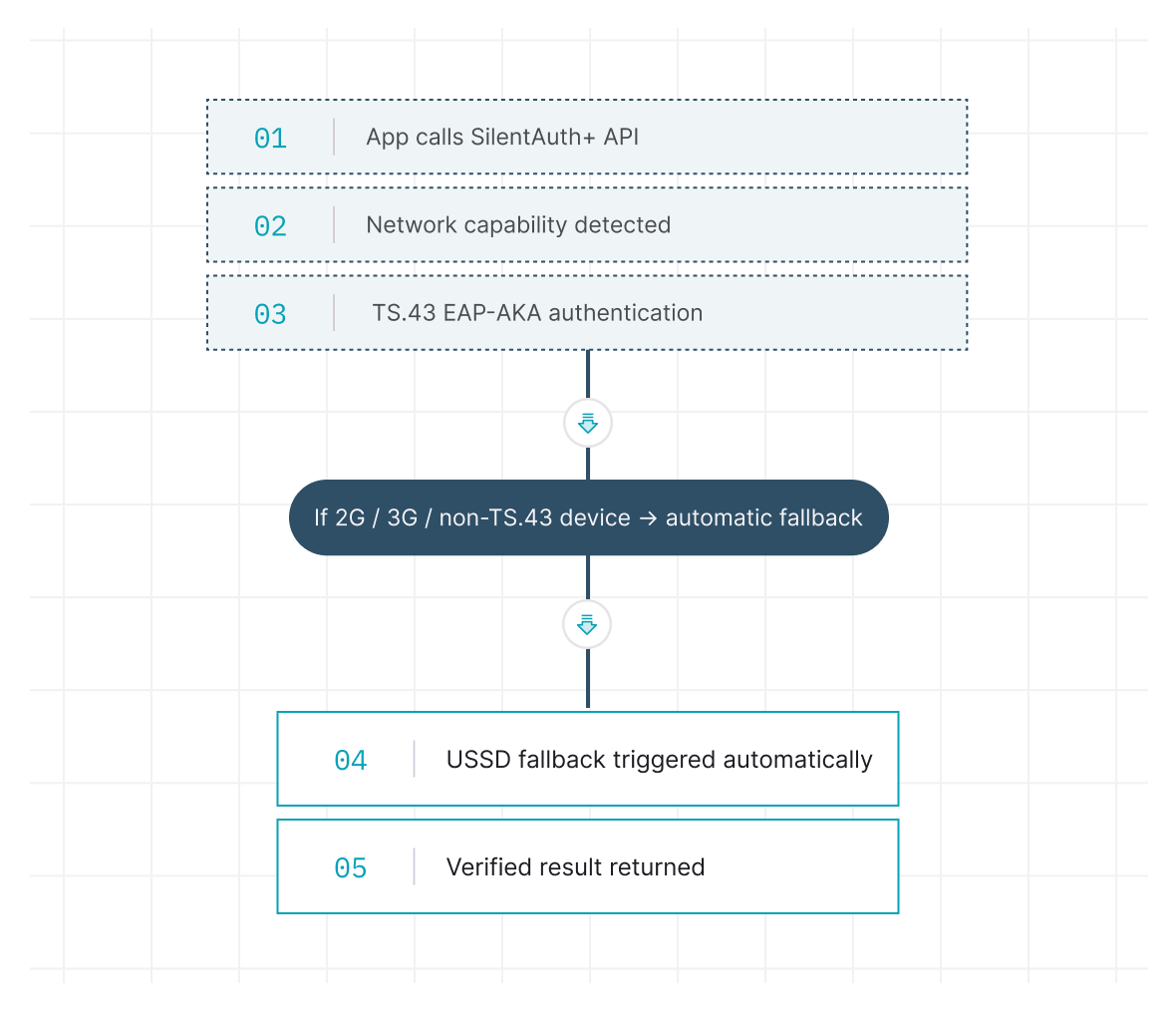
The EAP-AKA protocol works as follows: the device sends an authentication request to the Entitlement Server via the data channel; the ES contacts the MNO's Home Subscriber Server (HSS); the HSS returns the device's RAND/AUTN authentication vectors; EAP-AKA challenge-response completes; the device is verified. No OTP. No user interaction.

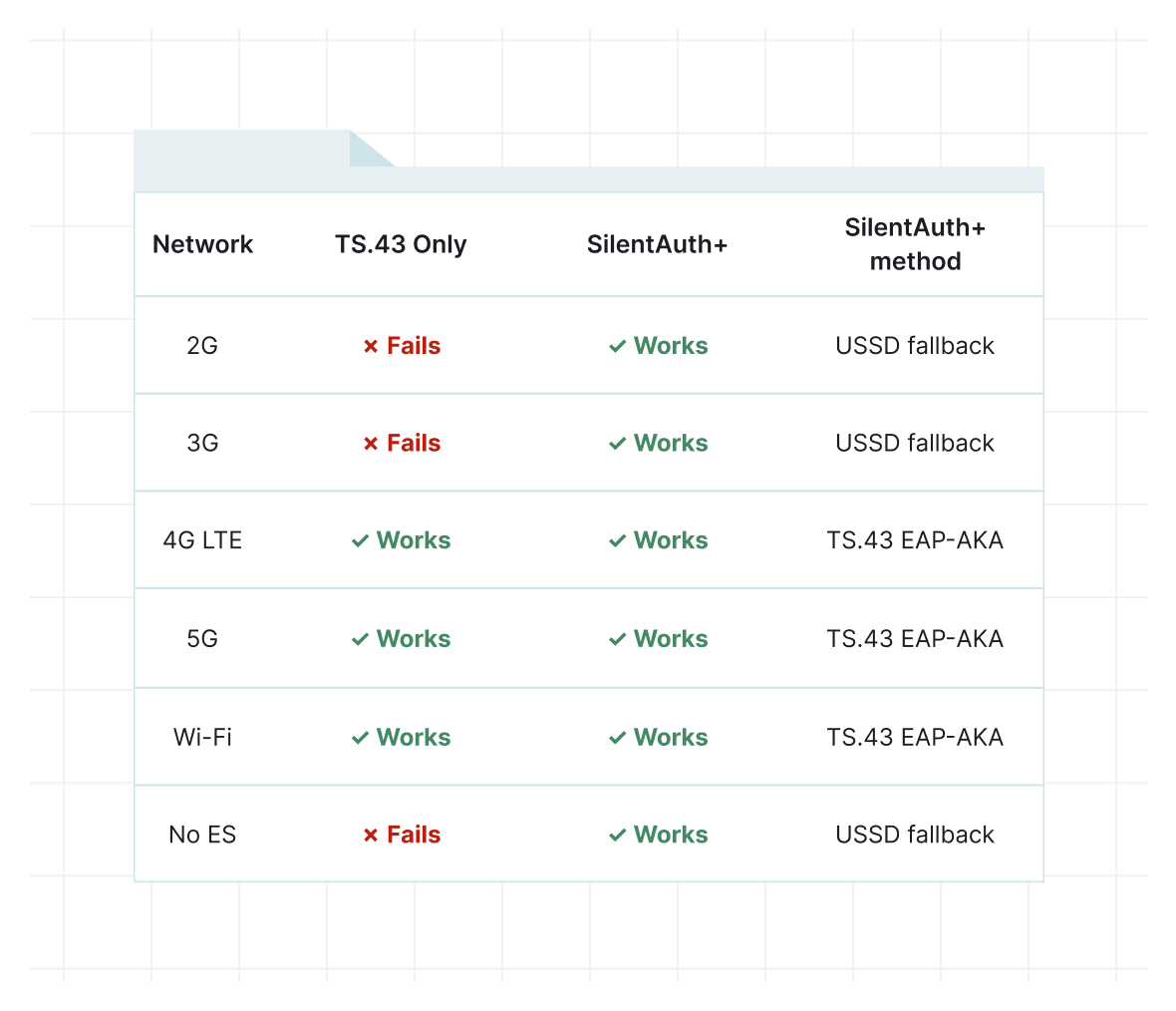
The limitation: TS.43 EAP-AKA requires an LTE (4G) or 5G connection and an MNO-side Entitlement Server. In markets where 2G/3G penetration is still significant (Sub-Saharan Africa, South Asia, Southeast Asia) a substantial share of authentications fail. SilentAuth+'s USSD fallback solves this, extending coverage to every GSM-capable device on any network generation.
PLATFORM: MESSAGE CENTRAL
TS.43 covers 4G and 5G. USSD covers everything else.
Every other silent authentication platform stops where LTE stops. When the device is on 2G, 3G, or when the MNO hasn't deployed a TS.43-compliant Entitlement Server, silent authentication fails — silently. The enterprise gets no verification. The user hits a fallback that was never designed for.

SilentAuth+ doesn't accept that trade-off. Our orchestration layer detects the device's network capability in real time and routes the authentication request accordingly: TS.43 EAP-AKA for LTE/5G devices, USSD for everything else. The enterprise API always gets a result. The user never notices.

In the markets U2opia serves — Africa, Southeast Asia, MENA, South Asia — 2G and 3G devices still represent a meaningful share of the addressable base. USSD fallback is not an edge case. It's the difference between a product that works everywhere and one that works only where infrastructure is already mature.
Why USSD is the right fallback for network authentication
Works on every mobile device
USSD operates over the GSM voice channel — no internet, no smartphone, no app. It's available on every mobile phone that can make a call.
Verified network identity not a code
USSD fallback confirms the device's network identity without transmitting a one-time password. No phishing surface. No interception risk.
Invisible to the enterpriseintegration
USSD fallback is handled entirely by SilentAuth+'s orchestration layer. The enterprise API returns the same verified signal regardless of which authentication path was used.
Outcomes over output
For MNO partners, USSD fallback means authentication revenue isn't limited to LTE subscribers — it covers the full subscriber base.
HOW SILENTAUTH+ COMPARES
SilentAuth+ vs SMS OTP
vs IP-based vs TS.43-only
Not all authentication methods are equal. Here's how silent authentication compares to the alternatives enterprises are currently using
SilentAuth+ (U2opia) SMS OTP IP-based auth TS.43-only
User interaction required
None - completely silent
User reads and types code None None
2G device coverage
USSD fallback
Yes No - needs data connection No - fails on 2G/3G
Works on Wi-Fi
TS.43 EAP-AKA
Yes No - IP mismatch on Wi-Fi Yes - when ES supports it
Phishing-resistant
No code to intercept
No - codes can be phished Partial Yes
SIM-swap detection built in
SIM mismatch flagged
No No Yes
Works without MNO Entitlement Server
USSD fallback
Yes Yes No - ES required
Cryptographic verification
EAP-AKA or USSD
No No Yes - EAP-AKA
GSMA CAMARA compliant
Number Verify API
N/A Partial Yes
Emerging market coverage
104+ operators
Yes Limited Limited - Need RS
Vulnerable to SS7 attacks
No
Yes - SS7 exploits No No
SilentAuth+ (U2opia) SMS OTP IP-based auth TS.43-only
User interaction required

None - completely silent
User reads and types code
None
None
2G device coverage

USSD fallback
Yes
No - needs data connection
No - fails on 2G/3G
Works on Wi-Fi

TS.43 EAP-AKA
Yes
No - IP mismatch on Wi-Fi
Yes - when ES supports it
Phishing-resistant

No code to intercept
No - codes can be phished
Partial
Yes
SIM-swap detection built in

SIM mismatch flagged
No
No
Yes
Works without MNO Entitlement Server

USSD fallback
Yes
Yes
No - ES required
Cryptographic verification

EAP-AKA or USSD
No
No
Yes - EAP-AKA
GSMA CAMARA compliant

Number Verify API
N/A
Partial
Yes
Emerging market coverage

104+ operators
Yes
Limited
Limited - Need RS
Vulnerable to SS7 attacks

No
Yes - SS7 exploits
No
No
USE CASES
Where SilentAuth+ replaces OTP in production today.
Enterprises use silent authentication wherever an OTP creates friction, fails silently, or introduces a security vulnerability.
BANKING & FINTECH
Mobile banking login & transaction verification
Banks use SilentAuth+ to verify the user is on their registered device before authorising high-value transactions — without interrupting the payment flow with an OTP that could be phished or intercepted via SS7.
E-COMMERCE
Account creation and checkout authentication
Remove the OTP step at account creation and checkout. Silent verification reduces abandonment at the point of highest drop-off and eliminates the SMS delivery failures that prevent genuine users from completing purchases.
GAMING & OTT
Frictionless onboarding at scale
Gaming and streaming platforms use SilentAuth+ to onboard users silently — no OTP delay, no copy-and-paste, no friction between a user clicking "Sign Up" and accessing content.
EMERGING MARKETS
Authentication where OTP delivery fails
In markets where SMS delivery is unreliable, SilentAuth+'s USSD fallback provides a more reliable authentication path than OTP — even on 2G feature phones with no data connection.
MOBILE NETWORK OPERATORS
Monetise network authentication as an API product
MNOs use SilentAuth+ to turn their TS.43 Entitlement Server infrastructure into a revenue-generating API product — sold to enterprises on a revenue-share model managed by U2opia.
03
Step-up authentication without app friction
Enterprise software uses SilentAuth+ for step-up authentication on sensitive operations — verify the user's device identity silently before revealing financial data, PII, or admin-level access.
FREQUENTLY ASKED QUESTIONS
Everything you need to know about Silent Network Authentication

What is Silent Authentication?

Silent Authentication verifies mobile users without sending an OTP or requiring any user action. Authentication happens at the mobile network level using SIM credentials.

How does Silent Authentication work?

Silent Authentication uses network-based identity verification, allowing applications to confirm a user's phone number through the mobile operator without displaying an OTP screen.

What is TS.43 Authentication?

TS.43 is a GSMA standard that enables silent authentication using EAP-AKA cryptographic verification through mobile network infrastructure.

Is Silent Authentication more secure than SMS OTP?

Yes. Silent Authentication eliminates OTP interception, phishing attacks, and code-sharing risks because no verification code is generated or entered.

What is the difference between Silent Authentication and OTP?

OTP authentication relies on a code sent to the user. Silent Authentication verifies the user directly through the mobile network without requiring any code entry.

What is USSD Fallback in Silent Authentication?

USSD fallback allows authentication to continue on devices or networks where TS.43 authentication cannot complete, extending coverage to older mobile devices.

 Which businesses use Silent Authentication?

Banks, fintech companies, telecom operators, digital wallets, super apps, eCommerce platforms, and enterprise applications use Silent Authentication to improve security and user experience.

GET STARTED
Ready To Reach Every Mobile User?
Start with SilentAuth+ and add customer experience and payments as you grow. One platform, carrier-grade, global.