SilentAuth+ for Operators
Your SIM infrastructure already authenticates every subscriber silently. Deploy TS.43, expose it via CAMARA Open Gateway, and earn per-authentication API revenue — while cutting AIT fraud on your own network.
104+
MNO network reach worldwide
60+
Countries via Open Gateway
<500ms
Verification latency
0
OTP codes — SIM match is the proof
THE OPERATOR OPPORTUNITY
Silent authentication is network intelligence you already own.
TS.43 makes it commercially accessible.

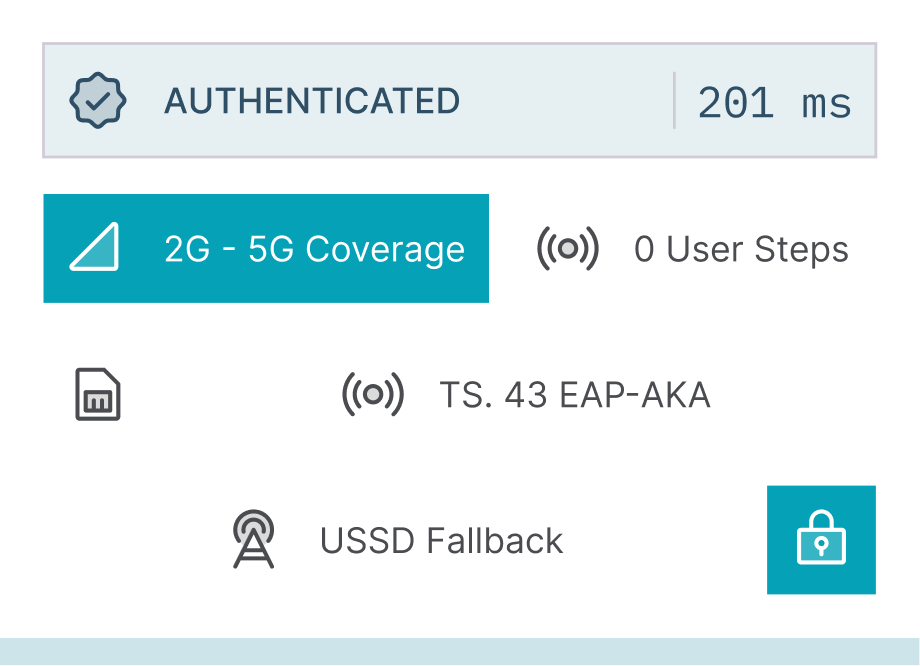
Every MNO continuously authenticates subscriber SIM cards across its network. TS.43 and CAMARA give operators the standardised infrastructure to expose that authentication intelligence as a revenue-generating API — for the first time, with full 2G–5G coverage via USSD fallback.
Enterprise triggers authentication
Enterprise calls U2opia SilentAuth+ API. U2opia routes to the subscriber's home MNO via phone number.
TS.43 entitlement token issued
Your TS.43 server issues a short-lived EAP-AKA token tied to the subscriber's SIM. No user action. No app permission. Network-side only.
SIM identity confirmed
EAP-AKA cryptographic handshake confirms the SIM is the legitimate subscriber — identical to your existing network authentication.
Result returned + revenue credited
Authentication result returned to enterprise. Per-authentication revenue share credited to your operator account.
OPERATOR REVENUE MODEL
New API revenue. Near-zero incremental network cost. AIT reduction as a bonus.
SilentAuth+ monetises an EAP-AKA operation your network already performs — the incremental compute and signalling cost is minimal. Revenue flows on two parallel tracks: direct API fees and AIT fraud reduction.
01
Direct per-authentication API revenue
Every SilentAuth+ call against your subscriber base generates per-event revenue. U2opia bills enterprises, settles with operators via GSMA Open Gateway commercial framework, and delivers monthly revenue reports.
02
AIT fraud reduction — protect OTP revenue
When enterprises migrate from OTP SMS to SilentAuth+, they remove A2P traffic that AIT fraudsters inflate. Each auth shifted is a unit of fraud surface eliminated — directly protecting legitimate A2P revenue.
03
Expanded enterprise market via aggregation
U2opia's 104+ operator network means enterprises integrate once and access all operators. Your capability is accessible to every enterprise in U2opia's network — without dedicated sales relationships.
04
GSMA Open Gateway differentiator in RFPs
Enterprises evaluating MNO partnerships for authentication increasingly require CAMARA Open Gateway compliance — your listing in the programme places you on enterprise RFP shortlists automatically.
DEPLOYMENT OPTIONS
Two paths to TS.43 deployment — hosted or on your own infrastructure.
Both options produce identical CAMARA API output and the same revenue model. The difference is where the TS.43 entitlement server runs and who operates it.
Option A — U2opia Hosted Option B — Operator-Deployed
Time to production
6–10 weeks
3–6 months
Infrastructure investment
None required
Operator hosts entitlement NF
Subscriber data
Authentication via operator HLR/HSS; U2opia hosts entitlement layer
All subscriber data stays within operator network
CAMARA API compliance
U2opia manages updates & versioning
U2opia provides API gateway; operator controls auth logic
USSD fallback
Included
Deployed as separate NF
Best for
Operators new to TS.43 — fastest path
Operators with existing NF deployment capability
Option A — U2opia Hosted Option B — Operator-Deployed
Time to production

6–10 weeks
3–6 months
Infrastructure investment

None required
Operator hosts entitlement NF
Subscriber data

Authentication via operator HLR/HSS; U2opia hosts entitlement layer
All subscriber data stays within operator network
CAMARA API compliance

U2opia manages updates & versioning
U2opia provides API gateway; operator controls auth logic
USSD fallback

Included
Deployed as separate NF
Best for

Operators new to TS.43 — fastest path
Operators with existing NF deployment capability
Get in Touch
WHY OPERATORS CHOOSE SILENTAUTH+
Unique advantages no other silent authentication solution offers operators.
From 2G–5G coverage to passive SIM swap detection, SilentAuth+ is built around the operator's network strengths — not around workarounds.
Only silent auth with 2G–5G coverage
USSD fallback extends SilentAuth+ to 2G and 3G subscribers with no internet required. No competitor delivers full generation coverage in a single silent authentication product.
CAMARA compliant — Open Gateway ready
SilentAuth+ exposes your capability via CAMARA REST APIs aligned with GSMA Open Gateway standards. CAMARA Fall25 meta-release compliance included out of the box.
Sub-300ms latency — enterprise SLA-grade
EAP-AKA authentication completes in under 300ms, meeting the latency requirements of enterprise applications that need inline authentication. No OTP delays or delivery retries.
SIM swap detection — enriched signal
Authentication events are correlated with SIM swap history. Recent swap? The authentication response carries a risk signal enterprises can use to trigger step-up verification.
AIT fraud surface reduction
Each enterprise authentication moved from OTP SMS to SilentAuth+ removes a unit of A2P traffic from the AIT fraud surface — measurable ROI, not just a security benefit for enterprises.
No custom enterprise sales required
U2opia's aggregation model exposes your capability to every enterprise in its network. Join once; U2opia handles enterprise relationships, billing, and commercial negotiations.
TECHNICAL ARCHITECTURE
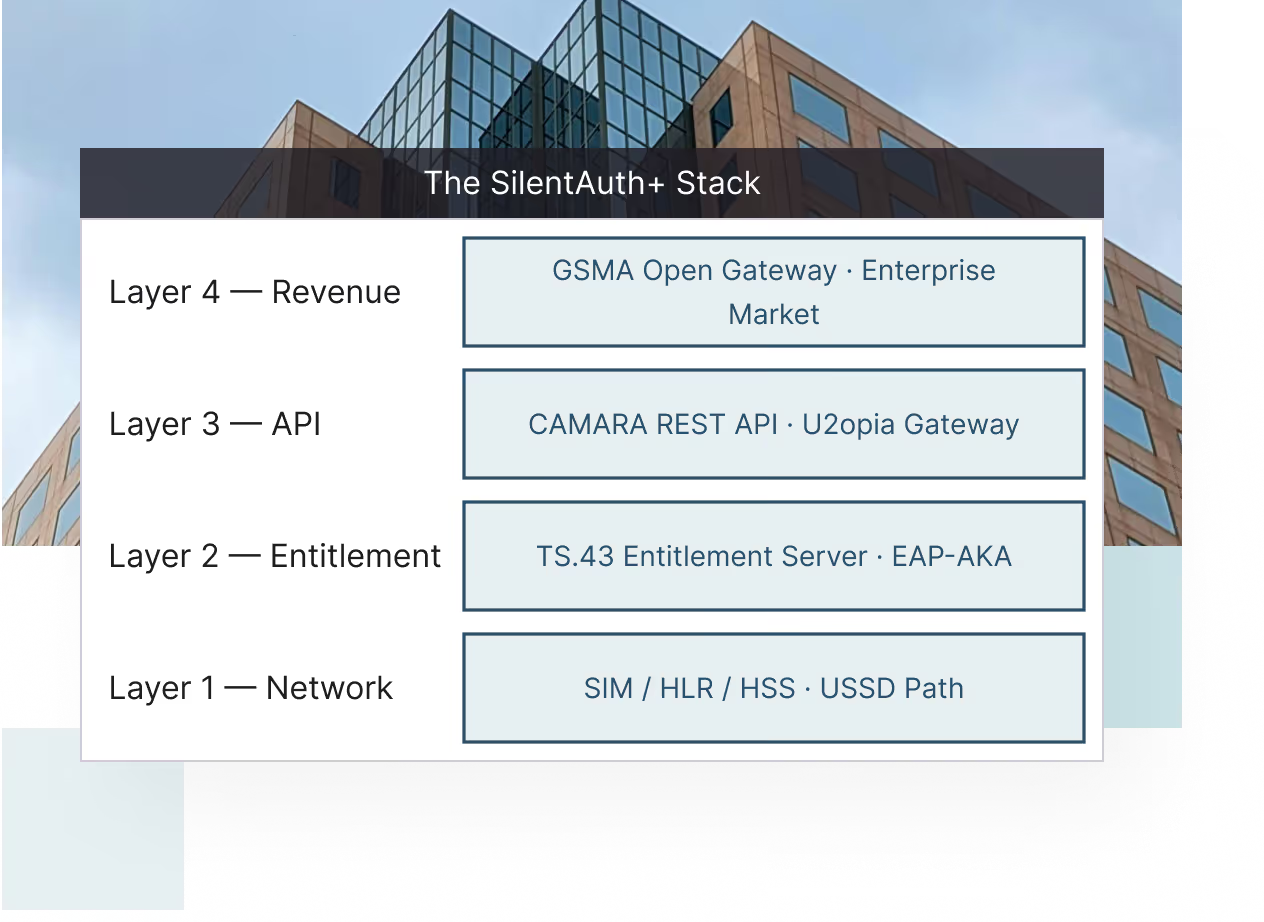
The SilentAuth+ stack — from SIM to CAMARA API in four layers.
SilentAuth+ is built on standard network functions and open interfaces. The operator contributes the authentication intelligence. U2opia contributes the entitlement layer, USSD path, CAMARA gateway, and enterprise network.
COMPETITIVE COMPARISON
SilentAuth+ versus other operator authentication API options.
Evaluate on coverage, standard compliance, and deployment complexity — not just headline latency numbers.
Capability SilentAuth+ (U2opia) TS.43 only (no aggregator) OTP SMS (status quo)
Authentication method
EAP-AKA cryptographic
EAP-AKA cryptographic Knowledge-based (OTP)
2G / 3G coverage
Yes — USSD fallback
No — 4G/5G only Yes
Wi-Fi authentication
Yes — CIBA + TS.43 token
Partial — CIBA required Yes (A2P SMS)
User step required
None — fully passive
None Yes — read + type code
CAMARA compliant
Yes — Fall25 stable
Requires custom work Not applicable
Enterprise aggregation
104+ MNOs, one API
Operator-by-operator Not applicable
AIT fraud reduction
Direct — replaces OTP traffic
Direct None — source of AIT
Deployment time
6–10 weeks (hosted)
12–24 months Existing
Operator revenue model
Per-auth revenue share
Custom per-enterprise negotiation A2P termination fee (AIT-contaminated)
SilentAuth+ (U2opia) TS.43 only (no aggregator) OTP SMS (status quo)
Authentication method

EAP-AKA cryptographic
Knowledge-based (OTP)
2G / 3G coverage

Yes — USSD fallback
No — 4G/5G only
Yes
Wi-Fi authentication

Yes — CIBA + TS.43 token
Partial — CIBA required
Yes (A2P SMS)
User step required

None — fully passive
None
Yes — read + type code
CAMARA compliant

Yes — Fall25 stable
Requires custom work
Not applicable
Enterprise aggregation

104+ MNOs, one API
Operator-by-operator
Not applicable
AIT fraud reduction

Direct — replaces OTP traffic
Direct
None — source of AIT
Deployment time

6–10 weeks (hosted)
12–24 months
Existing
Operator revenue model

Per-auth revenue share
Custom per-enterprise negotiation
A2P termination fee (AIT-contaminated)
FREQUENTLY ASKED QUESTIONS
SilentAuth+ for Operators — questions answered

What is silent authentication for mobile network operators?

Silent authentication is a SIM-based authentication method that verifies subscribers using network credentials without OTPs, passwords, or user interaction. Operators expose this capability through standard APIs and monetise it via GSMA Open Gateway.

How does TS.43 enable silent authentication?

TS.43 defines the entitlement framework that uses EAP-AKA cryptographic authentication to verify SIM identity and issue short-lived authentication tokens without requiring user action.

What is the difference between SilentAuth+ and OTP authentication?

OTP authentication relies on SMS delivery and user input, while SilentAuth+ performs authentication directly through the mobile network, providing lower friction, higher conversion rates, and better fraud prevention.

How do operators monetise silent authentication APIs?

Operators earn revenue whenever enterprises use their authentication APIs to verify subscribers. Revenue is generated on a per-authentication basis through the GSMA Open Gateway commercial framework.

Why is USSD fallback important for silent authentication?

USSD fallback enables silent authentication on 2G and 3G networks where mobile-data-based TS.43 authentication is unavailable, extending coverage to nearly the entire subscriber base.

How does silent authentication reduce OTP fraud and AIT attacks?

By replacing OTP SMS messages with network-based authentication, silent authentication removes the messaging flows that fraudsters exploit for Artificially Inflated Traffic (AIT) fraud.

Which industries use silent authentication APIs?

Banks, fintech companies, e-commerce platforms, gaming companies, OTT providers, and digital identity platforms use silent authentication APIs to improve onboarding, account security, and user experience.

GET STARTED
Ready To Reach Every Mobile User?
Start with SilentAuth+ and add customer experience and payments as you grow. One platform, carrier-grade, global.