.png)

Silent authentication eliminates all three. The verification happens between the device's SIM card and the mobile operator's network — invisible to the user, instant for the enterprise, and cryptographically stronger than any OTP-based method.
SilentAuth+ implements silent authentication using the GSMA TS.43 Release 11 standard — the GSMA's authoritative framework for network-level device authentication using EAP-AKA (Extensible Authentication Protocol — Authentication and Key Agreement). This is the same cryptographic mechanism mobile operators use to authenticate devices to their networks at registration.
.png)
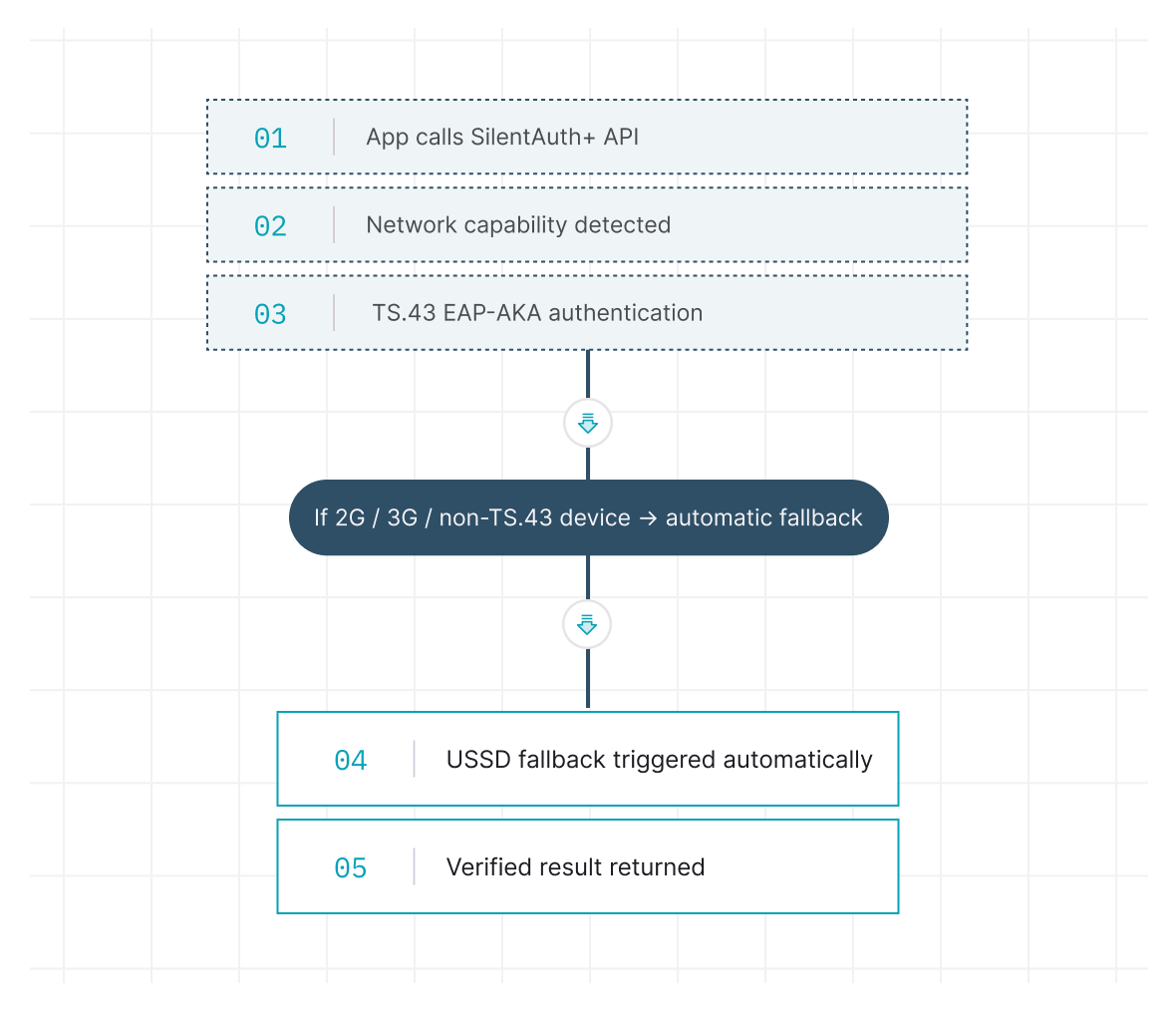
The EAP-AKA protocol works as follows: the device sends an authentication request to the Entitlement Server via the data channel; the ES contacts the MNO's Home Subscriber Server (HSS); the HSS returns the device's RAND/AUTN authentication vectors; EAP-AKA challenge-response completes; the device is verified. No OTP. No user interaction.
The limitation: TS.43 EAP-AKA requires an LTE (4G) or 5G connection and an MNO-side Entitlement Server. In markets where 2G/3G penetration is still significant (Sub-Saharan Africa, South Asia, Southeast Asia) a substantial share of authentications fail. SilentAuth+'s USSD fallback solves this, extending coverage to every GSM-capable device on any network generation.
SilentAuth+ doesn't accept that trade-off. Our orchestration layer detects the device's network capability in real time and routes the authentication request accordingly: TS.43 EAP-AKA for LTE/5G devices, USSD for everything else. The enterprise API always gets a result. The user never notices.
In the markets U2opia serves — Africa, Southeast Asia, MENA, South Asia — 2G and 3G devices still represent a meaningful share of the addressable base. USSD fallback is not an edge case. It's the difference between a product that works everywhere and one that works only where infrastructure is already mature.
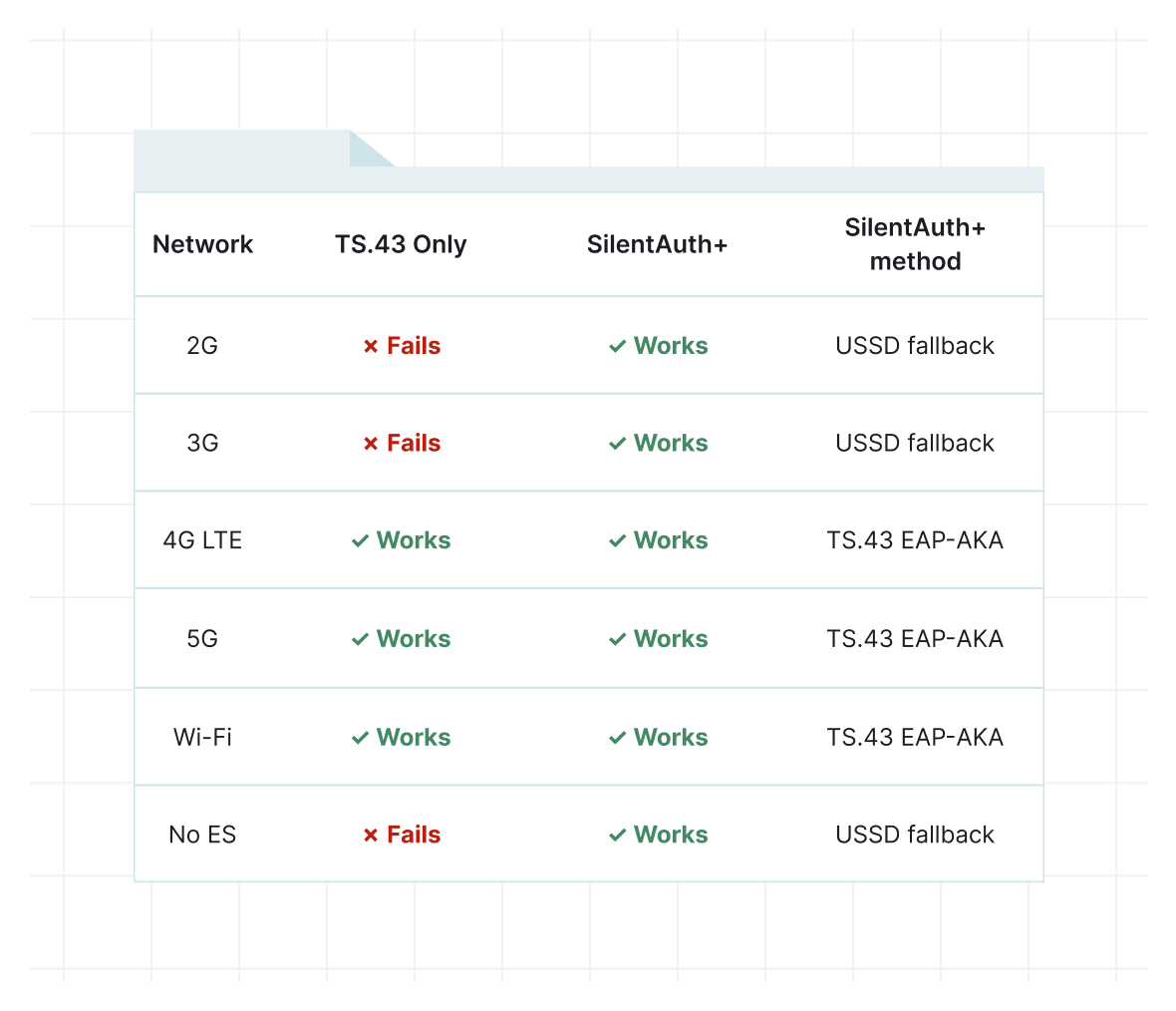


vs IP-based vs TS.43-only



How can telcos monetise authentication APIs?
Telcos can monetise authentication by exposing network-based identity APIs to enterprises, generating revenue from user verification instead of relying on declining SMS OTP traffic. This creates a new high-margin API revenue stream.
What is TS.43 authentication and why does it matter for operators?
TS.43 is a GSMA standard that enables SIM-based authentication using EAP-AKA across mobile and Wi-Fi networks. It allows operators to act as trusted identity providers instead of relying on third-party authentication methods.
How does silent authentication help telcos reclaim authentication from OTT players?
Silent authentication shifts identity verification from apps and SMS OTP back into the mobile network. This allows telcos to control authentication flows and capture value from every login and transaction.
What is Number Verify 2 (NV2) and how is it used by telcos?
Number Verify 2 is a GSMA Open Gateway API that confirms a phone number matches the active SIM card. Telcos can offer NV2 as a standardised API for real-time identity verification.
How does network-based authentication compare to SMS OTP?
Network-based authentication is faster, more secure, and does not require user input. Unlike SMS OTP, it is resistant to SIM swap fraud, phishing, and delivery failures.
Can telco authentication work across 2G, 3G, 4G, and 5G networks?
Yes, network-based authentication can work across all generations of mobile networks using a combination of TS.43, USSD fallback, and operator integrations.
How does authentication API revenue compare to SMS OTP revenue?
Authentication APIs provide scalable, usage-based revenue with higher margins, while SMS OTP revenues are declining due to fraud, regulation, and user friction.
What role do telcos play in digital identity and GSMA Open Gateway?
Telcos are positioned to become global identity providers through GSMA Open Gateway APIs like Number Verify. They can offer secure, interoperable identity services to enterprises worldwide.