NumberVerify2. Your network already knows.
NV2 is the CAMARA v2.0 standard that lets operators monetise phone number verification — no OTP, no user step. Its CIBA+TS.43 token extends verification to Wi-Fi, closing NV1's biggest gap.
104+
MNOs in U2opia's network
2G to 5G
Full coverage via TS.43 + USSD
<300ms
Silent auth latency — no OTP wait
0
User steps — fully passive authentication
WHAT IS NUMBERVERIFY2 (NV2)
Your network verifies every subscriber silently. NV2 makes that sellable.
NumberVerify2 is the CAMARA Number Verification API v2.0 — a GSMA Open Gateway standard that exposes the MNO's subscriber verification capability as a REST API.

Enterprises ask one question: "does this phone number match the SIM in this device?" The operator's network answers in under 500ms — no OTP sent, no code typed.
STEP 01
Enterprise calls API
App sends the phone number to verify via the U2opia NV2 endpoint.
STEP 02
Operator routing
U2opia routes to the correct MNO across 104+ operators.
STEP 03
Network-side lookup
The MNO checks the number against the SIM in the requesting device.
STEP 04
Match returned
Verified match or mismatch — sub-500ms, zero user action.
WHAT CHANGED
The Wi-Fi gap was NV1's biggest limitation. NV2 closes it.
NV1 only works when the device is on mobile data — on Wi-Fi, verification fails and falls back to OTP. NV2 pre-fetches a CIBA+TS.43 token tied to the SIM while mobile data is available, then completes verification over any connection. The result: the largest source of false negatives in number verification is eliminated.
NV2 (v2.0) NV1 (v1.0)
Wi-Fi verification
Yes — CIBA+TS.43 token
No — mobile data only
Token pre-fetch
Yes — CIBA flow
Not supported
CAMARA maturity
Stable (Fall25)
Stable (Spring24)
OTP required
No — SIM match is proof
SIM swap detection
Integrated signal
Separate API call
False negative rate
Significantly lower
High on Wi-Fi sessions
Recommended for
All new integrations
Legacy / migration
NV2 (v2.0) NV1 (v1.0)
Wi-Fi verification

Yes — CIBA+TS.43 token
No — mobile data only
Token pre-fetch

Yes — CIBA flow
Not supported
CAMARA maturity

Stable (Fall25)
Stable (Spring24)
OTP required

No — SIM match is proof
SIM swap detection

Integrated signal
Separate API call
False negative rate

Significantly lower
High on Wi-Fi sessions
Recommended for

All new integrations
Legacy / migration
FOR MOBILE NETWORK OPERATORS
You already verify every number.
NV2 turns it into API revenue.

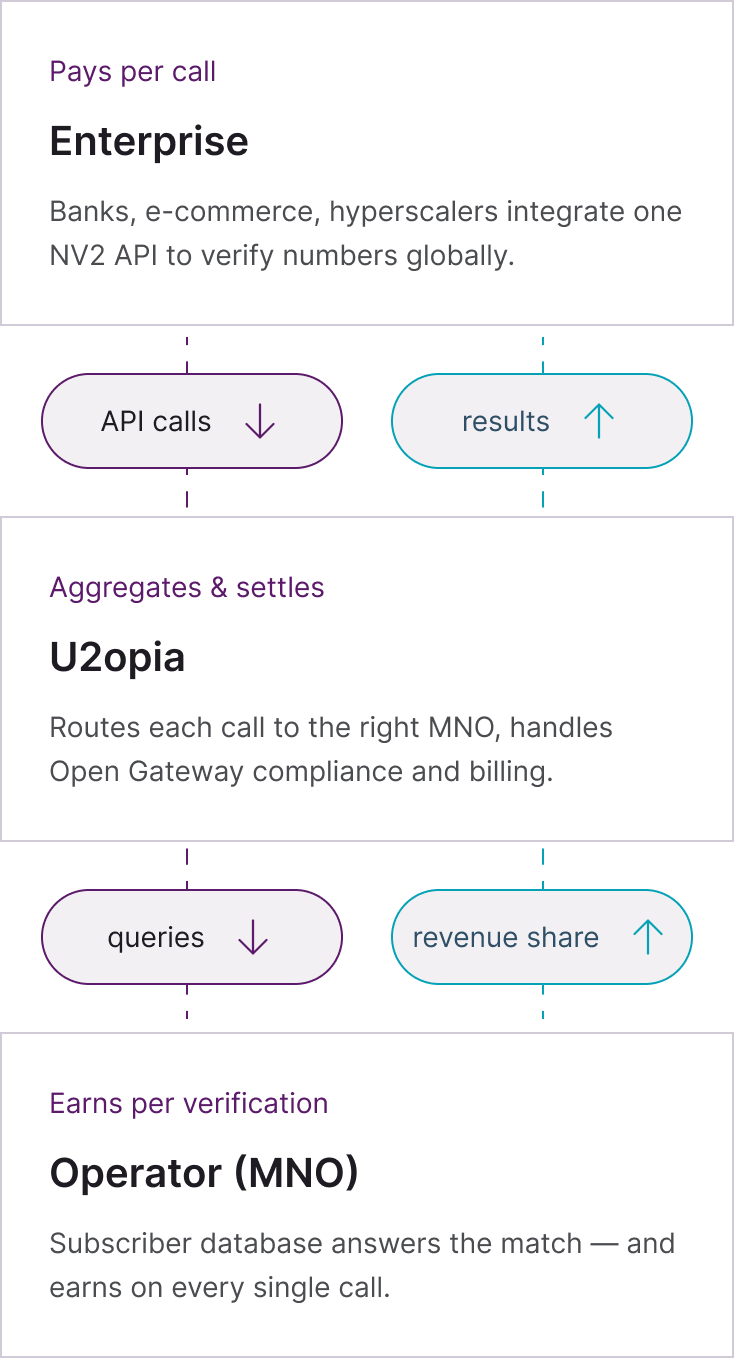
Through GSMA Open Gateway, enterprises pay per verification call against your subscriber database — a capability your network already runs at near-zero incremental cost. U2opia handles the CAMARA implementation, enterprise billing, and settlement; you receive a per-verification revenue share.
TECHNICAL SPECIFICATION
A production-grade CAMARA API, operator-native by design.
NV2 follows the CAMARA OpenAPI specification within the GSMA Open Gateway framework — interoperable with any compliant operator or aggregator. Everything below ships in U2opia's standard implementation.
Capability What it means Spec
Sub-500ms latency The subscriber lookup is a native network operation, not a user-facing round trip. avg ~280ms · p99 <500ms
CAMARA OpenAPI Standard REST specification, interoperable across operators and aggregators. CAMARA Fall25 · stable
GSMA Open Gateway Common commercial and technical framework across the operator ecosystem. 73+ groups · 285 networks
CIBA+TS.43 Wi-Fi extension Token pre-fetched on mobile data completes verification over Wi-Fi. TS.43 R11 · EAP-AKA
SIM swap signal Responses carry a risk flag if a SIM swap occurred in the last 72 hours. CAMARA Device Status
No OTP, no user step Entirely server-side — the user never sees a code, prompt, or wait state. Zero user friction
Sub-500ms latency
The subscriber lookup is a native network operation, not a user-facing round trip.
avg ~280ms · p99 <500ms
CAMARA OpenAPI
Standard REST specification, interoperable across operators and aggregators.
CAMARA Fall25 · stable
GSMA Open Gateway
Common commercial and technical framework across the operator ecosystem.
73+ groups · 285 networks
CIBA+TS.43 Wi-Fi extension
Token pre-fetched on mobile data completes verification over Wi-Fi.
TS.43 R11 · EAP-AKA
SIM swap signal
Responses carry a risk flag if a SIM swap occurred in the last 72 hours.
CAMARA Device Status
No OTP, no user step
Entirely server-side — the user never sees a code, prompt, or wait state.
Zero user friction
ENTERPRISE USE CASES
Who purchases NV2 — and why OTP no longer works for them.
Each enterprise segment driving NV2 adoption has a specific way OTP fails — by regulation, by friction, or by delivery. NV2 replaces the entire OTP chain with one silent network-side check.
Banking & BFSI
Network-based verification that satisfies the mandates.
E-Commerce & Fintech
Same fraud signal, zero friction, nothing to phish.
Gaming & OTT
Verification inside the API call; no SMS cost or wait.
Hyperscalers & Cloud
Confirms account number matches the SIM in the device.
Enterprise SaaS
Silent SIM-to-number check before privileged access.
Emerging Markets
No delivery dependency — verification is network-layer.
OPERATOR NETWORK REACH
104+ operators. 60+ countries. One NV2 API contract.
Enterprises integrate once against U2opia's NV2 endpoint and get global coverage — routing, Open Gateway commercials, and per-operator compliance handled. Operators joining the network gain immediate access to the full enterprise customer base.
South Asia (India+)
22+ MNOs
NV2 Ready
Southeast Asia
18+ MNOs
NV2 Ready
Middle East & Africa
24+ MNOs
Expanding
Europe
21+ MNOs
NV2 Ready
Americas
12+ MNOs
NV2 Ready
APAC (excl. SEA)
7+ MNOs
Expanding
FREQUENTLY ASKED QUESTIONS
NumberVerify2 (NV2) — questions answered

What is Silent Authentication?

Silent Authentication verifies mobile users without sending an OTP or requiring any user action. Authentication happens at the mobile network level using SIM credentials.

How does Silent Authentication work?

Silent Authentication uses network-based identity verification, allowing applications to confirm a user's phone number through the mobile operator without displaying an OTP screen.

What is TS.43 Authentication?

TS.43 is a GSMA standard that enables silent authentication using EAP-AKA cryptographic verification through mobile network infrastructure.

Is Silent Authentication more secure than SMS OTP?

Yes. Silent Authentication eliminates OTP interception, phishing attacks, and code-sharing risks because no verification code is generated or entered.

What is the difference between Silent Authentication and OTP?

OTP authentication relies on a code sent to the user. Silent Authentication verifies the user directly through the mobile network without requiring any code entry.

What is USSD Fallback in Silent Authentication?

USSD fallback allows authentication to continue on devices or networks where TS.43 authentication cannot complete, extending coverage to older mobile devices.

 Which businesses use Silent Authentication?

Banks, fintech companies, telecom operators, digital wallets, super apps, eCommerce platforms, and enterprise applications use Silent Authentication to improve security and user experience.

GET STARTED
Ready To Reach Every Mobile User?
Start with SilentAuth+ and add customer experience and payments as you grow. One platform, carrier-grade, global.