.png)

Your subscribers do not know their phone just authenticated to an entitlement server. They opened the dialer, made a call over Wi-Fi, and it worked. No prompt appeared. No code was required. Nothing asked for their attention.
That invisibility is not an accident. It is the design goal of silent authentication in TS.43. The entire entitlement provisioning flow runs in the background, powered by credentials already embedded in the SIM, before the subscriber ever needs the service.
When it works, it is one of the best examples of good UX in telecom: the complexity is hidden, the subscriber gets a seamless experience, and the operator has a provisioned device with verified entitlement. When it does not work, the failure is just as invisible, which creates an entirely different set of problems that this article addresses in detail.
What Silent Authentication Actually Is
Silent authentication in the TS.43 context is the process by which a device completes the full entitlement provisioning cycle without requiring any input from the user. The device handles everything autonomously, using its SIM as the authentication anchor.
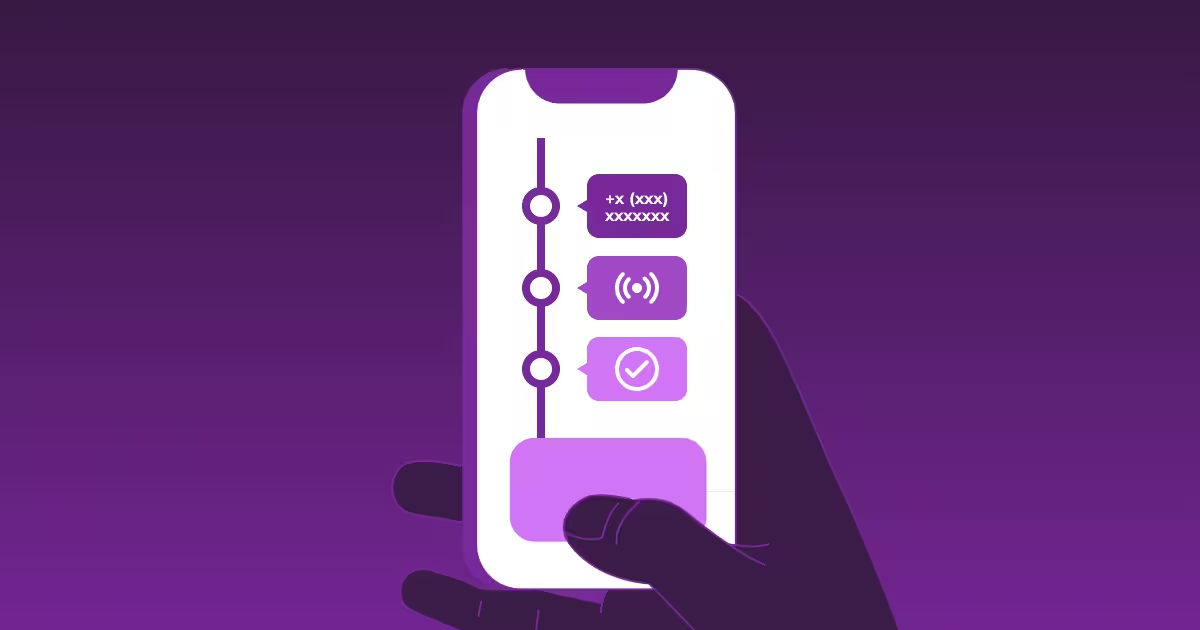
The flow begins with the device detecting a trigger: boot, SIM insertion, network registration, or a scheduled re-check interval. The device initiates contact with the entitlement server over a secure connection. Rather than presenting a username and password or waiting for the user to enter a code, it performs an EAP-AKA or EAP-AKA' exchange.
EAP-AKA uses the credentials stored on the USIM, specifically the subscriber's Ki and the associated authentication algorithms, to prove identity to the entitlement server. The entitlement server verifies this through the core network's authentication infrastructure, confirms the identity, and issues an entitlement token along with an XML configuration payload.
That payload tells the device exactly what it is entitled to: VoLTE, Wi-Fi Calling, specific IMS configurations, carrier feature flags. The device applies that configuration. The entire process completes in the background while the subscriber does something else entirely.
TECHNICAL DEFINITION: Silent authentication in TS.43 is an EAP-AKA or EAP-AKA' based entitlement provisioning flow in which the device authenticates autonomously using SIM credentials, with no user-visible prompts, no manual code entry, and no dependency on user action at any point in the flow.
The Triggers That Start a Silent Auth Flow
Understanding when silent auth fires is important for both operators and OEM integration teams. The triggers are not always intuitive.
The most common trigger is device boot. When the device starts up and registers to the network, it initiates an entitlement check. This is the baseline: every device that boots should leave that process with a current entitlement token.
SIM insertion is a second trigger. When a SIM is inserted or swapped, the device treats this as a new identity event and initiates a fresh entitlement check. This is important for dual-SIM devices and for subscribers who swap SIMs frequently.
Network registration changes, including transitions from cellular to Wi-Fi or between different network types, can trigger entitlement checks in some OEM implementations. Not all OEMs implement this trigger, which is one source of inconsistency in field behavior.
Token expiry is the fourth trigger. When the device's current entitlement token approaches or reaches its expiry time, it initiates a re-authentication to get a fresh token. The timing of this trigger relative to the actual expiry is a source of operational risk that we will cover in detail.
Why Silence Matters for Operators
Activation Rate Impact
The direct commercial case for silent authentication is activation rate. When subscribers have to take action to enable a service, some of them will not. Some will not notice the prompt. Some will dismiss it. Some will start the flow and abandon it halfway through.
Every step of a manual authentication flow has a drop-off rate. OTP flows require the subscriber to receive an SMS, recognize its relevance, open the appropriate interface, and enter the code correctly within a time window. Each of those steps has a failure probability. Multiply them together and you have a meaningful activation gap.
Silent authentication eliminates that gap. The device handles provisioning proactively. When the subscriber tries to use Wi-Fi Calling for the first time, the entitlement was already sorted at boot time. There is nothing for them to do.
For operators trying to drive adoption of IMS-based services, this is a material difference in outcomes. Markets that have moved to silent auth flows consistently see higher activation rates for services like Wi-Fi Calling and VoLTE compared to markets still using OTP-based provisioning.
Support Volume Reduction
Beyond activation rate, silent authentication reduces support volume. OTP-based flows generate a predictable stream of support contacts: subscribers who did not receive the OTP, subscribers who entered the code incorrectly, subscribers whose OTP expired before they could use it, and subscribers who completed provisioning on the wrong device.
Silent auth eliminates most of these contact reasons. The provisioning either succeeds automatically or it fails silently. The silent failures are a different support challenge, but the absolute volume of provisioning-related contacts drops substantially when the flow requires no user action.
Security Posture
Silent authentication is not just more convenient than OTP. It is more secure. The authentication anchor is a hardware-bound credential on the USIM. It cannot be intercepted in transit the way an SMS OTP can. It is not susceptible to SIM swap fraud in the same way, because the attacker would need physical access to the SIM, not just social engineering of the carrier's support staff.
EAP-AKA also provides mutual authentication. The device proves its identity to the entitlement server, and the server proves its identity to the device. An OTP flow authenticates the subscriber to the carrier, but does not authenticate the carrier to the subscriber. The EAP-AKA mutual authentication model is strictly stronger.
SECURITY NOTE: Silent authentication via EAP-AKA provides mutual authentication anchored to a hardware-bound SIM credential. This is significantly more resistant to interception, SIM swap fraud, and man-in-the-middle attacks than OTP-based flows. The security advantage is real, not just a marketing claim.
UX vs Security Trade-offs
The Opacity Problem
The same property that makes silent auth seamless for subscribers makes it difficult to audit. There is no user-visible event that marks the moment of authentication. Subscribers cannot tell whether their device has a current entitlement token. Support staff cannot ask a subscriber to "check if authentication completed" because there is nothing for the subscriber to check.
This opacity is a genuine operational challenge. When silent auth fails, the failure is invisible to the subscriber until they try to use the service and find it unavailable. At that point, they call support with a symptom report, and the support team has to work backwards from the symptom to identify whether the cause is an entitlement failure, an IMS configuration issue, a network problem, or something else.
Building subscriber-facing transparency into silent auth flows, even something as minimal as a settings screen showing "VoLTE: active" with a timestamp, reduces this diagnostic gap. It gives subscribers something to report and gives support staff a starting point.
Re-Authentication Timing Tension
Silent authentication creates a tension between freshness and efficiency. Tokens need to be refreshed periodically. But re-authentication has a cost: it consumes radio resources, creates load on the entitlement server, and introduces a window during which the device is operating on a token that is about to expire.
Aggressive re-authentication keeps tokens fresh but creates unnecessary server load and can cause token churn: situations where the device is re-authenticating so frequently that it invalidates tokens before they are used. Infrequent re-authentication reduces load but means devices can operate on stale entitlement data for extended periods.
The right balance depends on how frequently entitlement policy changes in your network and what the consequences of stale entitlement data are for your subscriber experience. There is no universal answer, but there are better and worse approaches, and we will cover the failure modes of both extremes in the companion article on silent auth failures.
Retry Risk
When a silent auth attempt fails, the device retries. This is correct behavior. But retry logic is not standardized, and the variance between OEM implementations creates genuine operational risk.
The core risk is what happens during an entitlement server outage. If the server goes down and every affected device starts retrying on a fixed schedule, the server faces a wave of synchronized retry traffic the moment it comes back online. Rather than recovering smoothly, it is immediately overloaded by the accumulated retries.
The correct retry pattern is exponential backoff with jitter, respecting any Retry-After headers the server sends. Not all OEM implementations do this. Some use fixed intervals. Some do not respect Retry-After. And some retry aggressively enough that a transient server issue becomes a sustained traffic problem.
The Logging Challenge
What Gets Logged and What Does Not
Silent authentication leaves minimal traces by default. The device does not log the authentication event in a subscriber-visible location. The entitlement server logs the attempt outcome, but the correlation between server logs and device state requires matching session identifiers that are not always preserved consistently across implementations.
On the device side, logging depth varies by OEM and by device model. Some OEMs provide detailed diagnostic logs that capture EAP-AKA exchange details, token issuance events, and configuration payload receipts. Others provide minimal logs that tell you whether the entitlement check passed or failed but nothing about why.
On the server side, the logging challenge is different. The entitlement server processes high volumes of requests. Retaining detailed logs for all authentication events is expensive. Most operators retain summary logs at scale and detailed logs only for failures or specific diagnostic windows.
Correlation Across Systems
The practical consequence of inconsistent logging is that diagnosing a silent auth failure requires correlating information from at least three systems: the device logs, the entitlement server logs, and the core network authentication logs. Each system uses its own identifiers. Mapping a device's session identifier to an entitlement server request ID to a core network authentication event is not trivial.
Some operators have built correlation pipelines that normalize these identifiers and make cross-system queries practical. Most have not. For those without correlation tooling, silent auth failure diagnosis is a manual, time-consuming process that often produces inconclusive results.
The investment in correlation tooling pays for itself quickly. Every support contact avoided and every incident resolved faster returns time and money. But it requires upfront architectural work that is easy to defer until after the next incident.
The Missing Middle
The most frustrating logging gap in silent auth flows is what we call the missing middle: the space between the device deciding to authenticate and the entitlement server receiving a request. If the authentication attempt fails before the server receives anything, the server has no log to examine. The device may have a log entry showing a failed attempt, but it contains no server response to analyze.
Missing middle failures are caused by network issues, DNS resolution failures, TLS handshake errors, and incorrect server address configuration in the device. They look like server failures from the device's perspective but do not appear in any server-side log at all. This class of failure is disproportionately common in Wi-Fi calling scenarios, where the device is connecting to the entitlement server over a Wi-Fi path it has not used before.
What Operators Should Instrument
Given the logging challenges inherent in silent auth flows, proactive instrumentation is more valuable than reactive diagnosis. Here is what meaningful monitoring looks like in practice.
Track entitlement check success rate by device model. Silent auth failure rates vary significantly by OEM and device model. A failure rate that looks acceptable at the aggregate level may mask a specific device model that is failing at a much higher rate due to an implementation issue.
Track token expiry events and re-authentication latency. If tokens are expiring before re-authentication completes, subscribers are operating with expired credentials. That gap, however short, is a service reliability risk.
Track retry behavior by device model. If specific device models are generating retry storms, that is visible in request volume patterns before it becomes an availability incident. Identifying and working with OEM partners to fix aggressive retry behavior is much cheaper than managing the outage it causes.
Track the missing middle. Correlation between device-side failure logs and server-side request logs can identify failure categories that never reach the server. The volume of those failures, segmented by network type and device model, points directly to the highest-value fixes.
OPERATOR ACTION: Build a dashboard that tracks: entitlement success rate by device model, token expiry to re-auth latency, retry event volume by device model and network type, and missing middle failure volume. These four metrics cover the majority of silent auth operational risk and are achievable with existing log data in most environments.
Silent Auth on Wi-Fi vs Cellular
Silent authentication behaves differently on Wi-Fi compared to cellular, and operators who treat them as equivalent in their monitoring and operational models will consistently misdiagnose Wi-Fi-specific failures.
On cellular, the device's network path to the entitlement server is well-defined. The APN routing, DNS resolution, and TLS configuration are controlled by the carrier. Failures tend to be systematic: if the entitlement server has an issue, it affects all cellular devices in a predictable pattern.
On Wi-Fi, the network path is not controlled. The device may be on a corporate network with TLS inspection. It may be on a public Wi-Fi network with a captive portal. It may be on a home network with a consumer router that has DNS rebinding protection enabled. Any of these can interfere with the silent auth flow in ways that do not affect cellular authentication at all.
Wi-Fi silent auth failures are more heterogeneous, harder to correlate, and more likely to affect specific subscriber populations. Segmenting your entitlement monitoring by network type is not optional if you want to understand your real failure landscape.
Frequently Asked Questions
What is silent authentication in TS.43?
Silent authentication in TS.43 is an automated entitlement provisioning process where a device uses EAP-AKA or EAP-AKA’ and SIM credentials to authenticate with an entitlement server without any user interaction. The flow runs in the background and provisions services like VoLTE and Wi-Fi Calling invisibly.
How does EAP-AKA enable silent authentication?
EAP-AKA uses the SIM’s hardware-bound credentials (Ki and authentication algorithms) to prove device identity to the network. The entitlement server verifies this through core network authentication infrastructure and issues a service entitlement token. The entire process happens without OTPs or user prompts.
What triggers a silent authentication check?
Common triggers include:
- Device boot
- SIM insertion or swap
- Token expiry
- Network registration changes (OEM-dependent)
- Scheduled re-check intervals
These triggers ensure entitlement tokens remain current.
Is silent authentication more secure than OTP?
Yes. Silent authentication uses SIM-bound cryptographic credentials and mutual authentication via EAP-AKA. Unlike OTP flows, it is resistant to SMS interception, SIM swap fraud, and man-in-the-middle attacks.
Why do silent authentication failures go unnoticed?
Silent authentication is designed to be invisible to the subscriber. If it fails, there is no prompt or error message. The failure often only becomes visible when a service like Wi-Fi Calling does not work, making diagnosis more complex.
What is a retry storm in silent authentication?
A retry storm occurs when devices repeatedly attempt entitlement authentication after a server outage. If retry logic lacks exponential backoff and jitter, devices can overload the server when it comes back online.
Why does silent authentication behave differently on Wi-Fi?
On cellular, the carrier controls routing and DNS. On Wi-Fi, the device may encounter TLS inspection, captive portals, DNS filtering, or firewall interference, making Wi-Fi silent auth failures more heterogeneous and harder to diagnose.
What should operators monitor in silent authentication flows?
Operators should monitor:
- Entitlement success rate by device model
- Token expiry to re-authentication latency
- Retry volume patterns
- Wi-Fi vs cellular failure segmentation
- “Missing middle” failures that never reach the entitlement server
Conclusion
Silent authentication is the right answer for TS.43 entitlement provisioning. The security model is stronger than OTP. The UX is better. The activation rates are higher. These are real advantages that operators should be capturing.
The challenge is that silent auth's greatest strength, its invisibility, is also its greatest operational risk. Failures are not surfaced to subscribers or support staff until a service stops working. Diagnosis requires cross-system correlation that most operators have not built. And retry behavior varies enough between OEM implementations that a single device model can create disproportionate server load during an incident.
Building operational visibility into silent auth flows is not optional. It is the difference between a provisioning architecture that you can operate confidently and one that creates periodic mysterious incidents that take days to diagnose.
About U2opia
U2opia provides silent authentication monitoring, token lifecycle analytics, OEM retry behavior diagnostics, and cross-system correlation tooling for telecom operators running TS.43-based entitlement infrastructure. Our platform is purpose-built for the operational realities of silent auth at carrier scale.