.png)

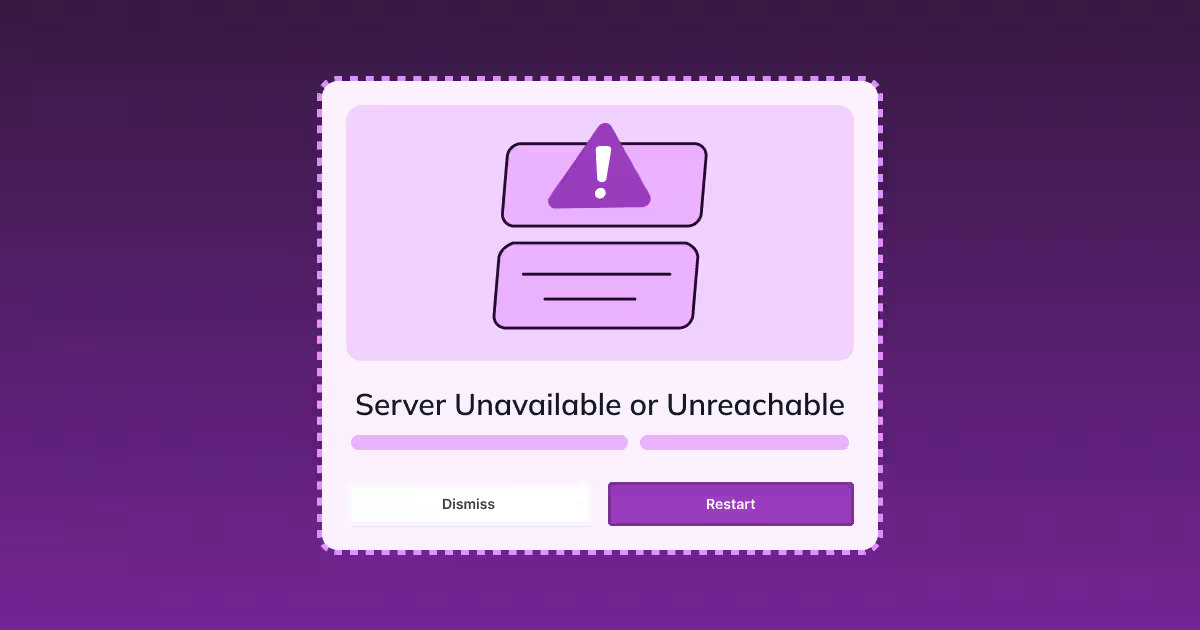
Entitlement servers sit quietly in the background of mobile networks, but when they fail, the impact is immediate and visible to subscribers.
Wi-Fi Calling does not activate. VoLTE registration fails. eSIM provisioning stalls. Customer care calls spike. (Read: Use cases of entitlement servers)
This article explains what really happens when an entitlement server is unreachable, overloaded, or times out, how GSMA TS.43 addresses these scenarios, and what mobile network operators should do to avoid service disruption.
(Read: How to implement an entitlement server?)
Why Entitlement Server Availability Matters for MNOs
An entitlement server decides whether a device is allowed to use a specific network feature. These features include VoWiFi, VoLTE, eSIM, and other operator-controlled services.
If the entitlement server is slow or unavailable, the network cannot make timely decisions. For the subscriber, this looks like a service that simply does not work.
For MNOs, entitlement server availability directly affects:
- Service activation success rates
- Customer experience and churn
- Call center volumes
- Compliance with GSMA standards
This is why entitlement servers are considered mission-critical infrastructure.
If you are evaluating entitlement risks in your network, connect with us to review your current setup.
What Is an Entitlement Server According to GSMA TS.43?
GSMA TS.43 defines the architecture and behavior of entitlement servers used by mobile operators.
In simple terms, an entitlement server:
- Receives entitlement requests from devices (read how entitlement servers support apple and samsung devices)
- Validates subscriber and device eligibility
- Returns a decision to allow or deny a service
These decisions often happen during:
- Device onboarding
- Network registration
- Feature activation such as Wi-Fi Calling
TS.43 focuses on interoperability, message flows, and basic behaviors. It does not fully define how operators should design resilience, fallback, or high availability. That responsibility remains with the MNO.
Where the Entitlement Server Fits in the MNO Network
In a typical MNO architecture, the entitlement server sits between:
- User devices
- IMS and VoWiFi platforms
- Backend subscriber and policy systems
The entitlement server is often accessed in real time. This means:
- Slow responses affect call setup times
- Timeouts block service activation
- Failures can propagate across multiple services
Because entitlement checks are often triggered by the device, any issue is immediately visible to the end user.
Common Entitlement Server Failure Scenarios
Entitlement Server Is Unreachable
This happens when the device or network cannot reach the entitlement server at all.
Common causes include:
- Data center outages
- DNS failures
- Network routing issues
- Firewall misconfigurations
When the entitlement server is unreachable, devices cannot retrieve entitlement decisions. In most cases, this results in:
- Wi-Fi Calling not activating
- VoLTE registration being delayed or denied
- Device setup failures
Unless fallback logic is in place, services simply stop working.
If you want to understand how your network behaves in this situation, connect with us for a failure scenario assessment.
Entitlement Server Is Overloaded
Overload is more common than complete outages.
It usually occurs during:
- Mass device rollouts
- eSIM migrations
- Network incidents that trigger retries
When the entitlement server is overloaded:
- Response times increase
- Requests queue up
- Devices may retry aggressively
This can create a feedback loop where retries make the overload worse.
From the subscriber perspective, the service feels unstable or inconsistent.
Entitlement Request Timeouts
Timeouts happen when the entitlement server responds too slowly, even though it is technically reachable.
Causes include:
- Backend database delays
- Poor capacity planning
- Inefficient entitlement logic
Timeouts are particularly dangerous because:
- Devices may retry multiple times
- User experience degrades without clear errors
- Operators struggle to diagnose the root cause
Timeout handling is a critical part of entitlement server design.
What GSMA TS.43 Says About These Scenarios
GSMA TS.43 defines how entitlement requests and responses should work, but it intentionally avoids prescribing operational behavior.
TS.43:
- Allows retry mechanisms
- Supports graceful handling at the client side
- Leaves fallback behavior to operator implementation
In other words, TS.43 compliance alone does not guarantee service continuity.
MNOs must design their own resilience strategies on top of the specification.
How MNOs Handle Entitlement Server Failures in Real Networks
Most production networks implement some form of fallback logic.
Common approaches include:
- Caching entitlement decisions on the device for a limited time
- Allowing temporary service access during outages
- Applying default policies when the server is unreachable
Each approach involves trade-offs between:
- Security
- Service continuity
- Regulatory compliance
There is no one-size-fits-all solution. The right approach depends on the service, the risk profile, and regulatory constraints.
If you need help defining the right fallback strategy, connect with us to explore best practices.
Best Practices for Entitlement Server Resilience
Design for High Availability
Entitlement servers should never be a single point of failure.
Best practices include:
- Active-active deployments
- Geographic redundancy
- Load balancing across multiple instances
This ensures that a single failure does not disrupt services nationwide.
Plan for Scale and Traffic Spikes
Capacity planning must account for:
- Peak activation events
- Retry storms during incidents
- Future service growth
Load testing and stress testing are essential to avoid overload scenarios.
Monitor What Actually Matters
Effective monitoring goes beyond uptime.
Operators should track:
- Response times
- Timeout rates
- Error patterns
- Request volumes
This allows teams to detect entitlement issues before customers notice.
If you want to benchmark your entitlement platform against these practices, connect with us to know more.
Impact on Key MNO Services
Entitlement server failures directly affect:
- Wi-Fi Calling activation
- VoLTE registration and continuity
- eSIM provisioning and profile downloads
In many cases, subscribers blame the device or the network, not the entitlement server. This increases support costs and churn risk.
A resilient entitlement server reduces customer complaints and protects revenue.
Read: Entitlement Server deployment checklist for MNOs
Security and Regulatory Considerations
Fallback mechanisms must be designed carefully.
Key concerns include:
- Preventing unauthorized service access
- Meeting regulatory requirements
- Ensuring auditability of entitlement decisions
Security and resilience must be balanced, not traded off. (Read: Security in Entitlement Servers)
How to Future-Proof Your Entitlement Server Strategy
Leading MNOs are moving toward:
- Cloud-native entitlement platforms
- Automated scaling and failover
- Proactive analytics and alerting
Aligning entitlement architecture with evolving GSMA standards ensures long-term flexibility and reliability.
Frequently Asked Questions
What happens if an entitlement server is unreachable?
If an entitlement server is unreachable, most operator services such as Wi-Fi Calling, VoLTE, and eSIM activation fail to start. The device cannot retrieve an entitlement decision, so the network does not allow the service.
Some MNOs reduce the impact by using cached or temporary entitlements on the device. Without these mechanisms, service activation usually fails immediately.
How long can cached entitlements be used when the entitlement server is unavailable?
Cached entitlements are usually valid for a limited time defined by the mobile network operator. The validity period depends on operator policy, service type, and security requirements. Once the cache expires, the device must contact the entitlement server again to refresh its entitlement before the service can continue.
Can Wi-Fi Calling work if the entitlement server is down?
Wi-Fi Calling can work when the entitlement server is down only if cached or temporary entitlements are already available. If the device has a valid cached entitlement from a previous successful check, it may continue using Wi-Fi Calling for a limited time. If no cached entitlement exists, Wi-Fi Calling typically fails to activate until the entitlement server becomes reachable again. (read: how is the device authenticated on an entitlement server?)
Final Thoughts
Entitlement servers are critical to modern mobile networks, even though they are rarely visible.
When they are unreachable, overloaded, or slow, services fail instantly and customers notice.
GSMA TS.43 provides a foundation, but resilience, scalability, and operational excellence are the responsibility of the MNO.
If you want to review, modernize, or harden your entitlement server deployment, connect with us to know how we help MNOs build resilient, GSMA-compliant entitlement solutions.