.png)

Introduction: Why Silent Authentication Exists at All
We have all experienced it.
You open an app, try to log in, and wait for an OTP that arrives late, never arrives, or arrives after you already asked for a resend.
This friction is exactly why silent authentication exists.
Silent authentication removes the OTP step entirely by verifying the user through the mobile network itself. No codes. No typing. No delays. The user does nothing, yet authentication still happens securely.
Behind this seemingly simple experience is a critical network component that rarely gets talked about outside telco circles: the entitlement server.
This article explains how entitlement servers enable silent authentication, where GSMA SGP.22 TS.43 fits in, how Silent Network Authentication (SNA) works, and why OTPs are increasingly becoming a fallback rather than the default.
What Is Silent Authentication?
Silent authentication is a method of verifying a user’s identity without requiring any user input such as OTPs, passwords, or verification links.
Instead of asking the user to prove who they are, the network does it automatically by validating:
- The SIM or eSIM identity
- The mobile subscription status
- The device and network context
- Secure cryptographic credentials at the telecom layer
If the network confirms the user is legitimate, authentication succeeds silently in the background.
This makes silent authentication:
- Faster than OTPs
- More reliable than SMS delivery
- Harder to intercept or phish
- Ideal for high-scale consumer applications
But silent authentication does not work by magic. It depends on entitlement validation.
What Is an Entitlement Server?
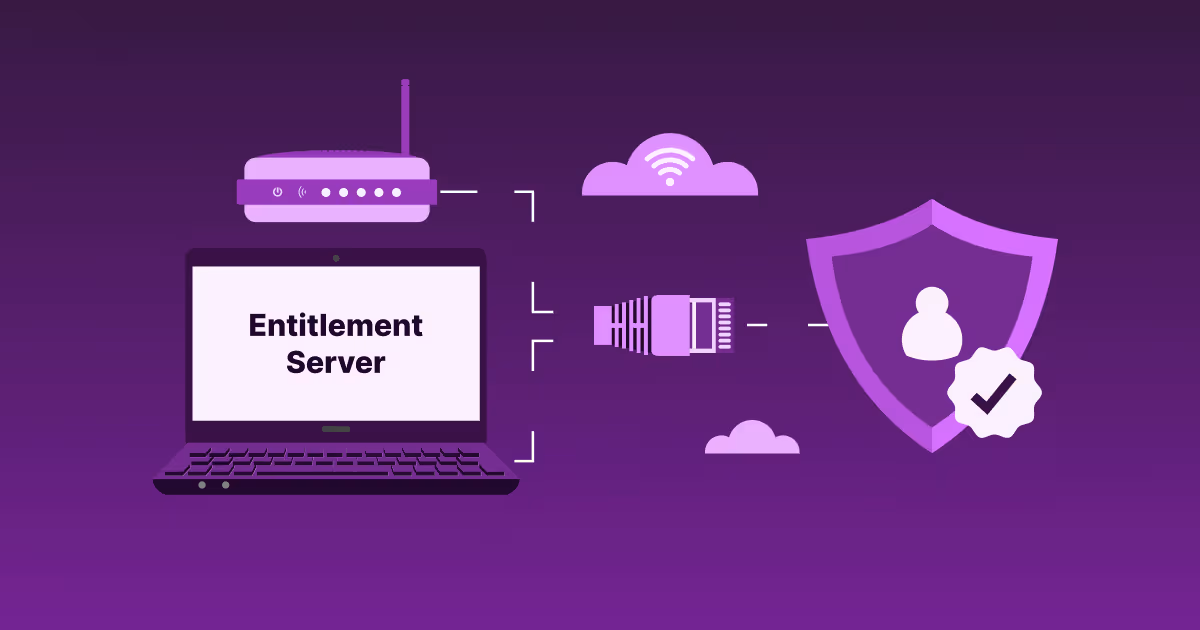
An entitlement server is a network component used by mobile operators to decide what services a device or subscription is allowed to use.
At a high level, an entitlement server checks:
- Is this a valid SIM or eSIM?
- Is the subscription active?
- Is this device allowed to use this service?
- Are network and policy conditions satisfied?
Entitlement servers are commonly used to enable services such as:
- VoLTE and VoWiFi
- SMS over IP
- eSIM and companion device activation
- On-device service activation (ODSA)
These checks are standardized so that devices, networks, and operators behave consistently.
This is where GSMA SGP.22 TS.43 comes in.
Where GSMA SGP.22 TS.43 Fits In (And Where It Does Not)
It is important to be precise here.
GSMA SGP.22 TS.43 does not define silent authentication as a standalone concept.
What it does define is:
- Entitlement flows for IMS services
- On-Device Service Activation (ODSA)
- Secure authentication mechanisms such as EAP-AKA
- How devices communicate with entitlement servers for service authorization
In simple terms:
TS.43 standardizes the entitlement checks that make silent authentication possible.
Silent authentication is the outcome.
Entitlement validation is the mechanism.
Without TS.43-based entitlement flows, there is no reliable way for a network to silently verify that a device and subscription are legitimate.
How Entitlement Servers Enable Silent Authentication
Here is what actually happens during silent authentication:
- A mobile app or service initiates authentication.
- The request is routed through the mobile network rather than over the public internet.
- The network triggers an entitlement check.
- The entitlement server validates the SIM or eSIM using cryptographic authentication such as EAP-AKA.
- The server confirms subscription status, device eligibility, and policy compliance.
- A secure confirmation is returned to the application.
At no point does the user receive an OTP or need to interact.
This works because:
- The SIM or eSIM already contains secure credentials.
- The entitlement server already knows what the subscription is allowed to do.
- The authentication happens entirely within trusted telecom infrastructure.
Silent Network Authentication (SNA): The Broader Framework
Within GSMA and CAMARA initiatives, silent authentication at scale is often referred to as Silent Network Authentication (SNA).
SNA is commonly exposed to applications through APIs such as:
- Number Verification API
- Network identity verification APIs
These APIs allow applications to verify:
- That the user owns the phone number
- That the device is currently attached to the mobile network
- That the request originates from the legitimate subscriber
What powers SNA behind the scenes is still the same thing:
entitlement servers validating subscription and device identity using TS.43-aligned flows.
SNA is the application-facing layer.
Entitlement servers are the network-side enforcement.
Why Silent Authentication Is Replacing OTPs
OTPs have served the industry well, but they have limitations:
- SMS delivery delays
- SIM swap attacks
- Phishing and social engineering
- User friction and drop-offs
Silent authentication removes these problems by:
- Eliminating message delivery entirely
- Reducing attack surface
- Improving login and onboarding conversion rates
- Scaling better for high-traffic applications
That is why many modern apps now use silent authentication as the primary authentication method.
Why OTPs Still Exist (And Probably Always Will)
Silent authentication is not a complete replacement in every scenario.
In regulated or high-risk environments such as:
- Banking and payments
- Financial services
- Enterprise access
- Sensitive account changes
OTPs are often layered on top of silent authentication, not replaced by it.
This satisfies compliance requirements such as:
- PSD2 strong customer authentication
- Financial regulatory audits
- Regional telecom regulations
- Risk-based authentication policies
In practice:
- Silent authentication establishes network-level trust.
- OTPs provide explicit user confirmation when required.
OTPs become a fallback or additional layer, not the default first step.
Where Silent Authentication Works Best
Silent authentication delivers the most value in:
- App login and signup
- Returning user verification
- Fraud reduction
- SIM-based identity verification
- Markets with reliable mobile network coverage
It is especially effective when combined with entitlement-based validation rather than application-level heuristics.
Common Misconceptions About Silent Authentication
Does silent authentication work over WiFi?
No. Silent authentication requires mobile network attachment. Over WiFi, fallback methods such as OTP or app-based authentication are needed.
Does TS.43 define silent authentication?
No. TS.43 standardizes entitlement and ODSA flows that enable silent authentication using SIM or eSIM credentials.
Is silent authentication less secure than OTP?
In many cases, it is more secure because it avoids SMS interception and phishing risks.
Conclusion: Entitlement Servers Are the Quiet Enablers of Passwordless UX
Silent authentication feels effortless to users because the hard work happens deep inside the network.
Entitlement servers, standardized through GSMA SGP.22 TS.43, provide the trust anchor that allows networks to verify identity silently, securely, and at scale. Silent Network Authentication builds on this foundation to deliver frictionless experiences that OTPs simply cannot match.
As telecom APIs, eSIM adoption, and network-based identity services continue to evolve, entitlement servers will only become more central to authentication strategies.
The future of authentication is quieter, faster, and far less annoying for users. And entitlement servers are the reason why.
FAQs
Q) How is an entitlement server related to silent authentication?
An entitlement server validates SIM or eSIM identity, subscription status, and device eligibility. Silent authentication relies on these entitlement checks to verify users without OTPs or passwords
Q) What is Silent Network Authentication (SNA)?
SNA is a GSMA and CAMARA framework that enables applications to verify users at the network level without user interaction. It is built on entitlement validation and network-based authentication.
Q) Are OTPs still required if silent authentication is available?
In many high-risk or regulated scenarios, OTPs are layered on top of silent authentication to meet compliance requirements. Silent auth often acts as the first trust signal.

.png)